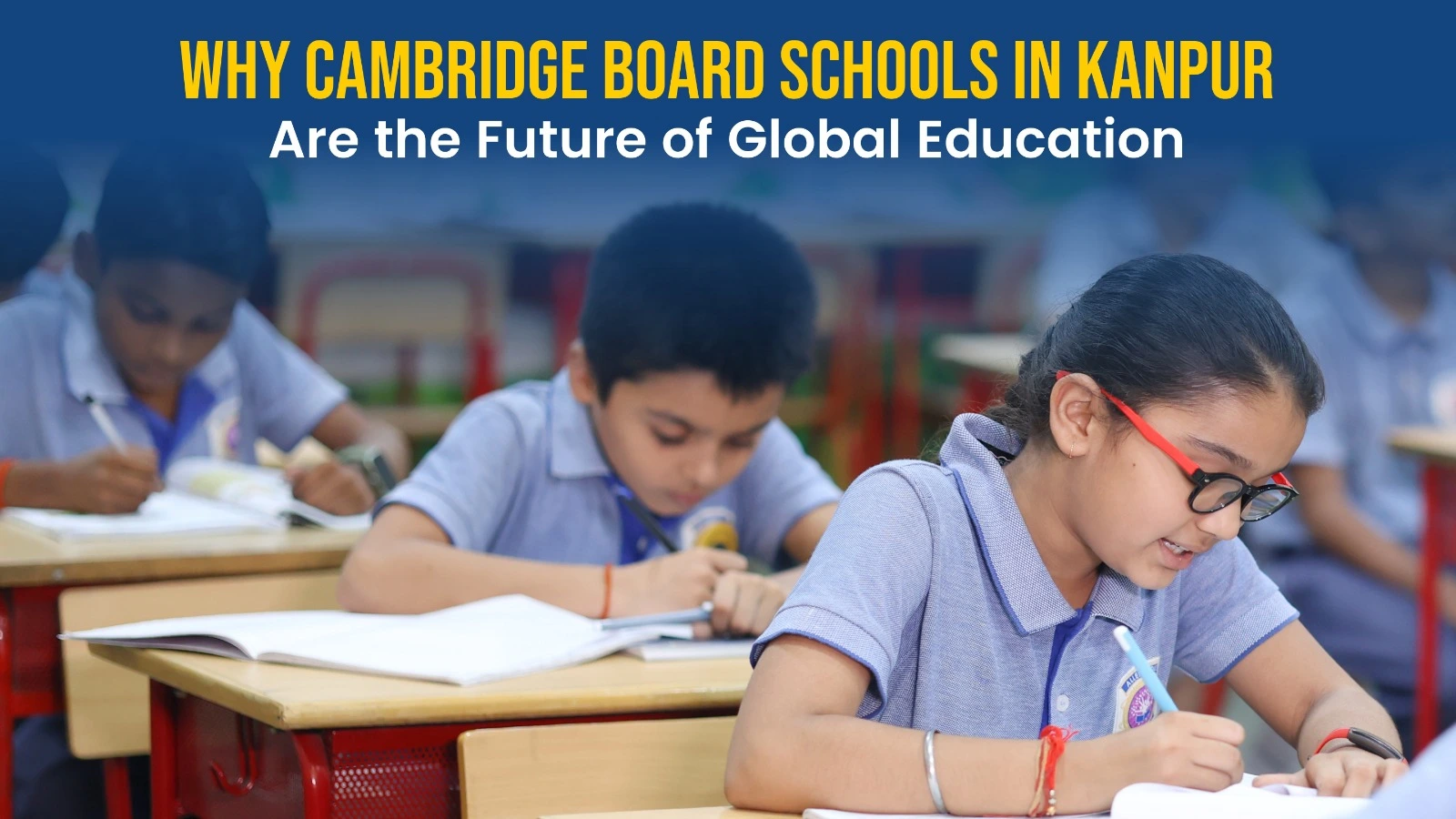
Why Cambridge Board Schools in Kanpur Are the Future of Global Education
With global recognition, inquiry-based, concept-deep, skill-first approach Cambridge board is quickly becoming the apple of everyone’s eye. Here is a detailed insight into why and how Cambridge Board Schools in Kanpur are serving the future of global education.
Introduction
For decades, the conversation about school boards in this city, as in most of India, centred on two questions: CBSE or ICSE? The answers were predictable. CBSE for competitive exams. ICSE for English and breadth. The same debate, recycled at every parents' gathering for thirty years.
But a third option has quietly moved from the periphery to the conversation and the parents who've explored it aren't going back.
Cambridge Board schools in Kanpur are growing in number, growing in reputation, and growing in the proportion of Kanpur's most aspirational families who choose them. It is a response to a genuine shift in what the world requires of young people and what the best education must therefore offer them.
This article brings you why the Cambridge board is not just an alternative to CBSE and ICSE, but a different kind of education altogether. One built for the world your child will actually graduate into.
What Is the Cambridge Board? Why Does It Matter?
The Cambridge Assessment International Education (CAIE), commonly known as the Cambridge board, is the world's largest provider of international education programmes. It operates in over 160 countries. More than 10,000 schools worldwide are Cambridge-affiliated. Its qualifications are recognised by universities in the UK, USA, Canada, Australia, Singapore, and increasingly, by Indian universities under NEP 2020.
But statistics don't explain why parents are choosing it. What explains that is what the Cambridge board actually does differently.
At its core, the Cambridge programme is built on a single philosophy: that education should develop the whole learner.
Among Cambridge board schools in Kanpur, the ones delivering on this philosophy produce a specific kind of student- one that Kanpur's families, and India's best universities, are increasingly recognising.
Cambridge vs CBSE vs ICSE: An Honest Comparison
Before making the case for Cambridge, it's worth situating it honestly against the boards most Kanpur families are familiar with. Every board has genuine strengths. This table doesn't declare a winner, it maps the differences.
The honest takeaway: Cambridge isn't universally better than CBSE or ICSE. For a student whose entire focus is on cracking JEE Main, a CBSE school with strong NCERT teaching remains the most efficient route. For a student with ambitions that extend beyond India or one who learns best through inquiry, project work, and application rather than exam reproduction, Cambridge board schools in Kanpur offer something neither CBSE nor ICSE can.
6 Reasons Cambridge Board Schools in Kanpur Are the Future
Cambridge schools are a new-favourite and the reasons are plentiful. Here are the main reasons why and how they help students get ready for their lives ahead:
#1. The World's Best Universities Already Speak Cambridge
This is a claim about recognition. Cambridge results are accepted as entry qualifications by over 7,000 universities globally, including Oxford, Cambridge, MIT, Harvard, Stanford, the National University of Singapore, and an increasing number of IITs and NITs under India's evolving NEP 2020 framework.
A student from a Cambridge-affiliated school in Kanpur doesn't need to sit additional bridge courses or equivalency tests for admission to most international institutions. Their qualification speaks directly in the language that admissions offices at global universities understand. For Kanpur families with children who may study abroad or who want to keep that option genuinely open, this recognition is more than a bonus. It's the point.
At Allenhouse Public School, Khalasi Lines, Kanpur, students are prepared from Cambridge Primary through to higher levels. Students who complete their education here emerge with qualifications that open doors to Indian and international universities with equal credibility.
We also run structured university guidance from Class 9 onwards, domestic and international, so students understand what their options are and how to pursue them.
#2. It Teaches Children How to Think
The most important shift in Cambridge education is the one hardest to articulate on a brochure: it changes how students relate to knowledge.
In a conventional exam-focused system, students learn answers.
In a Cambridge classroom, students learn to question, investigate, evaluate, and argue.
The examination itself is designed to test whether a student can apply understanding to situations they haven't seen before, not whether they can reproduce notes they've memorised.
This distinction sounds philosophical. Its consequences are practical. Students trained to think rather than memorise are more adaptable in university environments, more capable of independent research, and more equipped for professional contexts that require judgment rather than recall. Among Cambridge board schools in Kanpur, this is the most significant differentiator from other boards.
Inquiry-based learning at Allenhouse Kanpur is not an approach reserved for science subjects. It is the default pedagogy across subjects. Students are asked to
Evaluate, not just recall.
Present arguments, not just reproduce facts.
Work on projects that require them to investigate real problems and build a genuine understanding.
The result? It's students who find learning interesting because they're participants in it, not spectators.
#3. English as a Thinking Tool
The Cambridge board's relationship with English is fundamentally different from how other boards treat it. English in a Cambridge school is not just the language through which subjects are taught. It is the lens through which thinking itself is developed. Cambridge English programmes, right from Cambridge Primary English, are specifically designed to develop students who can
read complex material critically,
write with precision and persuasion
listen actively
speak with structured confidence
In the global professional context your child will enter, English isn't just a communication skill. It's a competitive advantage. The ability to write a compelling argument, conduct a rigorous analysis, or hold a sophisticated conversation in English is what separates candidates at every career level.
The best Cambridge board school in Kanpur treats English not as a subject on the timetable, but as the medium through which thinking becomes articulate and visible. This is what families who have visited us most consistently tell us they notice: not that students speak English, but how they speak it.
#4. Preparation for a World That Doesn't Yet Exist
The World Economic Forum estimates that 65% of children currently in primary school will work in job types that don't exist today. Artificial intelligence is restructuring every industry. Automation is eliminating routine work. The economy your child will participate in by 2035 looks nothing like the one that shaped the syllabi of most Indian school boards twenty years ago.
Cambridge, by contrast, is built for this uncertainty. Its global outcomes framework, which guides every Cambridge school worldwide, explicitly targets the development of confident learners, responsible citizens, reflective thinkers, innovative contributors, and engaged global citizens. These are not feel-good aspirations. They are the specific cognitive and social attributes that research consistently identifies as the most valuable in a rapidly changing global economy.
Allenhouse Kanpur's curriculum integrates the Cambridge global outcomes framework across all year groups. Students engage with current global challenges through
Interdisciplinary projects
Environmental and social responsibility initiatives
Model United Nations programme that puts global thinking into practice.
We don't limit teaching students to what the world is. We equip them to shape what it will be.
#5. Assessment That Measures Real Capability
How a board assesses students tells you more about what it values than any curriculum document. Cambridge assessments are deliberately designed to test application, analysis, and evaluation. Some standard components of Cambridge are:
Extended response questions
Case study analyses
Research projects
Practical investigations
Students cannot 'pattern-match' their way through a Cambridge paper the way they can through many conventional exam formats.
The implication for parents is this: a student who performs well in Cambridge examinations has genuinely understood the material. Their grade is a credible signal of capability, not a reflection of effective coaching or last-minute preparation.
For families choosing among Cambridge board schools in Kanpur, this is the quality that makes Cambridge grades mean something to universities worldwide.
#6. Holistic Education Because Capability Is More Than Academic
Cambridge is an academic framework but its philosophy is explicitly holistic. The Cambridge learner profile describes students who are not just academically strong, but also confident communicators, responsible community members, reflective practitioners, and creative problem-solvers. The board's design reflects a belief that education's purpose extends beyond examination results.
This matters increasingly in the world your child is entering. Employers, universities, and communities are looking for people with judgment, empathy, and the ability to work across differences. These are qualities that no examination, by itself, can build. A Cambridge board school in Kanpur that takes this philosophy seriously produces graduates who are qualified and have character.
At Allenhouse Kanpur, holistic development is not a section of the school calendar. It is woven into the daily school experience:
Sports
Performing arts
Debates and declamations
MUN
Community service
Student leadership initiatives
These are real programmes with dedicated time, trained facilitators, and genuine expectations of participation. We produce students who can lead a classroom discussion, captain a team, perform on a stage, and articulate a policy position with equal confidence. That breadth is what Cambridge-educated students bring to the world.
Is Cambridge the Right Choice for Your Child? An Honest Answer
The Cambridge board is not the right choice for every family in Kanpur. Here is an honest assessment of when it is and when it isn't.
Cambridge is likely the right choice if:
Your child has aspirations that may extend beyond India. Cambridge qualifications are globally recognised. If there is any chance your child may study or work internationally, Cambridge keeps those doors open in a way other boards don't.
Your child is a curious, inquiry-oriented learner. Students who ask 'why' more than 'what' thrive in Cambridge environments. The board rewards genuine thinking over memorisation.
You want education that develops the whole person. If academic marks are important but not the only thing that matters to you, and you want a school that genuinely builds character, communication, and creativity alongside results, Cambridge's philosophy matches that priority.
You value English as a genuine academic skill. Cambridge English development is the most rigorous English programme available in any Indian school board context. For families who see English as a long-term professional asset, this matters.
You are interested in humanities, social sciences, arts, or business careers. Cambridge's breadth makes it particularly well-suited for students whose interests extend beyond the pure sciences, where CBSE's NCERT focus is strongest.
Cambridge may not be the first choice if:
Your child's primary goal is cracking JEE or NEET. CBSE's direct NCERT alignment with these exams gives CBSE students a structural preparation advantage. Cambridge students can and do succeed in these exams, but CBSE aligns best.
Your family may relocate frequently across Indian cities. CBSE's national standardisation makes mid-year school transitions much smoother. Cambridge school density varies across cities.
You need a school that is widely available across price points. Cambridge-affiliated schools in Kanpur are currently concentrated in the premium segment. CBSE schools serve a far broader range of family contexts.
Allenhouse Public School, Kanpur: Education Done Right
Among Cambridge board schools in Kanpur, Allenhouse Public School stands apart through a combination of Cambridge academic rigour, 28+ years of the Allenhouse Group's educational legacy, and a genuine commitment to the holistic Cambridge philosophy.
Here is what makes Allenhouse the school worth visiting:
The full Cambridge pathway: From Cambridge Primary to higher levels- the complete progression, delivered with the depth each stage demands.
Inquiry-first teaching:Our teachers are trained and evaluated on their ability to teach for understanding. Formative assessment, project-based learning, and student-led inquiry are daily practices.
English excellence built in: As a Cambridge-affiliated school in Kanpur, English development happens across every subject and every year. Our students command it.
Global exposure that is real: MUN, international olympiads, virtual exchange programmes, and globally contextualised curriculum ensure students engage with the world beyond their classroom walls.
Holistic, not just academic: 17+ sports options, arts, debate, leadership, community service and more. We opt for a structured, timetabled, and expected approach for every student.
What’s truly unique?
At Allenhouse Public School, Khalasi Lines, Kanpur, we present an option. You can choose from CBSE and Cambridge. So, whether you are looking for the best Cambridge board school in Kanpur or a CBSE one, come and see what learning looks like at Allenhouse.
Schedule a campus visit or book a school tour. Begin your child's journey today!
Your Queries Answered
Which are the Cambridge board schools in Kanpur?
Cambridge board schools in Kanpur are currently concentrated in the premium school segment, with Allenhouse Public School being a leading Cambridge-affiliated institution in the city. As Cambridge education grows in demand, the number of CAIE-affiliated schools in Kanpur is expanding.
What is the best Cambridge board school in Kanpur?
Allenhouse Public School, Kanpur, is widely regarded as the best Cambridge board school in Kanpur for its full Cambridge pathway, inquiry-based pedagogy, structured English development, global exposure programmes, and the institutional strength of the 28+ year Allenhouse Group.
Is Cambridge board better than CBSE for students in Kanpur?
Neither board is universally better. For students primarily targeting JEE or NEET, CBSE's direct alignment with NCERT remains the most efficient preparation pathway. For students with international university aspirations, an inquiry-based learning preference, Cambridge board schools in Kanpur are a good choice.
Are Cambridge qualifications recognised by Indian universities?
Yes, and increasingly so under NEP 2020. Cambridge qualifications are formally recognised by the Association of Indian Universities (AIU) and accepted by an expanding list of IITs, NITs, and central and state universities.
What is a Cambridge-affiliated school in Kanpur?
A Cambridge-affiliated school in Kanpur is a school that has been formally registered with Cambridge Assessment International Education (CAIE) and is authorised to teach Cambridge programmes and enter students for Cambridge examinations.